Kitchen Gadgets Worth Having: A Practical Guide
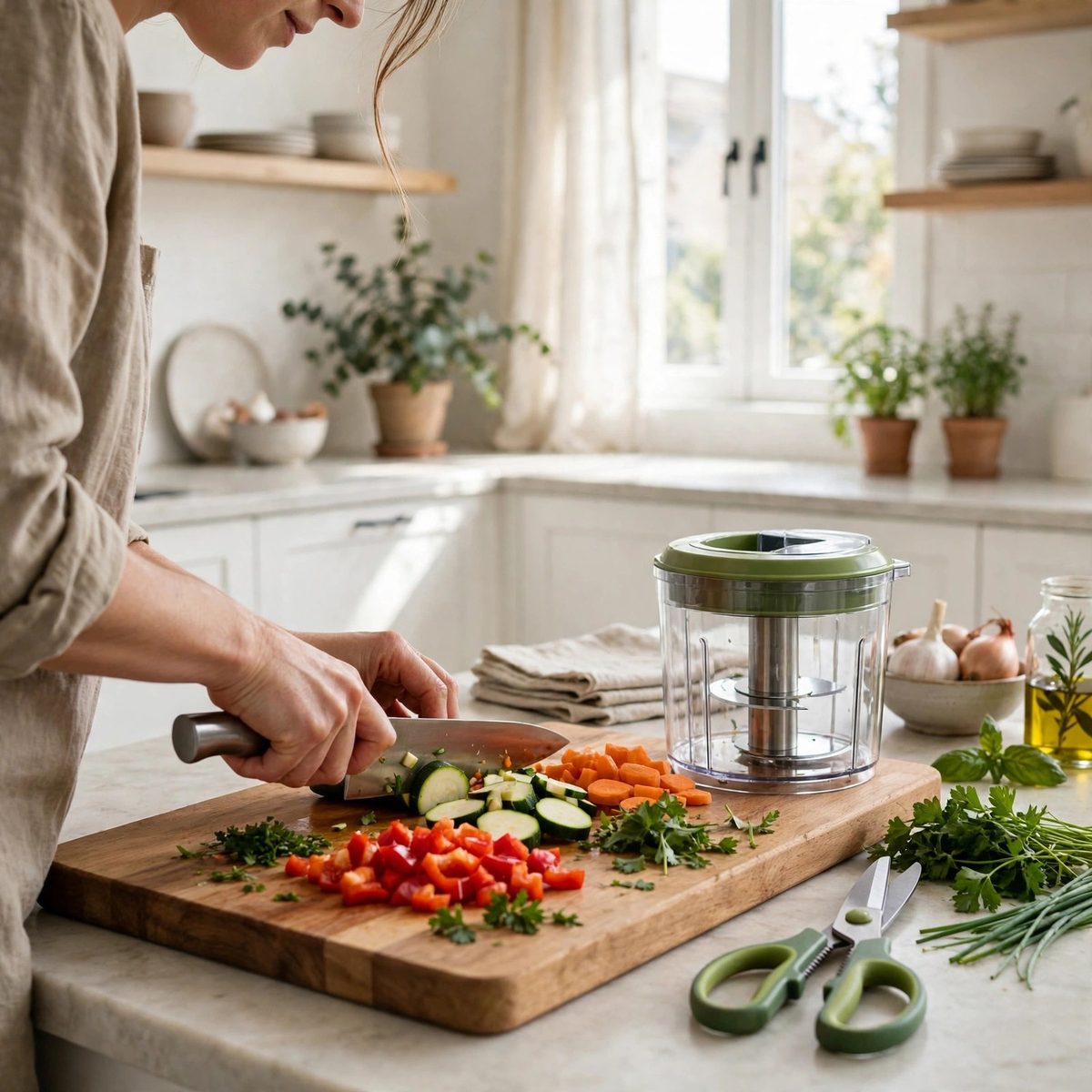
Every kitchen has a drawer with a gadget that seemed like a good idea and never got used again. At the same time, most cooks have one or two tools they reach for every single day — the chopper that cuts prep time in half, the scale that makes baking reliable, the press that saves ten minutes of peeling and mincing. The difference between those two kinds of gadget is not price or brand. It is whether the tool matches the cooking you actually do.
This article looks at the kitchen gadgets that tend to earn their keep, why they work, and how to decide which ones belong in your kitchen. It is written for ordinary home cooks, not professionals, and it focuses on tools that solve real, repeated problems.
What makes a kitchen gadget worth having?
A gadget is worth having when it does one of three things: it saves a meaningful amount of time, it makes a job noticeably easier, or it gives you a result that is hard to get by hand. A vegetable chopper saves time on a nightly task. A mandoline slicer gives you even, thin slices that are difficult to cut by hand. A digital scale gives you consistent measurements that cups cannot match.
It is also worth asking what a gadget costs you. Not just the price, but the space it takes, the time it takes to clean, and the effort of getting it out and putting it away. A tool that saves five minutes of chopping but takes five minutes to wash and dry has not really saved you anything. The gadgets that earn their place are the ones where the benefit clearly outweighs the hassle.
The chopper: cutting prep time on everyday meals
Chopping is the most common prep job in a home kitchen. Onions, peppers, carrots, potatoes — most evening meals start with a board full of vegetables and a knife. A chopper does that job faster and with less effort, and it keeps the pieces a consistent size, which helps them cook evenly.
The BrightNest Vegetable Chopper with Container has a clear container that catches the chopped vegetables as you press the lid down, so there is no mess on the board and nothing to sweep into a bowl. The container also means you can chop, store and measure in one place. If you make salads, stir-fries, soups or salsas regularly, a chopper is one of the first gadgets to consider, because it works on the job you do most.
When you use a chopper, cut larger vegetables into pieces that fit the chamber first, and press the lid down with steady pressure rather than forcing it. Rinse the blades and the container straight after use — dried vegetable fibres are much harder to clean later. Dry the parts fully before storing them, and keep the lid closed so dust doesn't settle inside.
The mandoline slicer: even slices, every time
Some dishes depend on even slices. Potatoes for a gratin, cucumbers for a salad, onions for a tart — if the slices are uneven, some cook faster than others and the result is patchy. A mandoline slicer gives you uniform slices at a thickness you choose, and it does it far faster than a knife.
The BrightNest Mandoline Slicer with Guard has adjustable blades and a hand guard, and the guard matters: a mandoline blade is sharp, and the guard keeps your fingers away from it. Always use the guard, especially as the vegetable gets smaller. Work slowly and steadily rather than rushing — speed is not the point, consistency is.
A mandoline is a good example of a gadget that earns its place only if you cook the dishes it suits. If you slice vegetables thinly once a week or more, it is a strong buy. If you rarely need thin, even slices, a sharp knife will do the same job with less to store and clean.
The garlic press and herb scissors: small tools, daily use
Some of the most useful kitchen gadgets are the smallest. A garlic press turns peeling and mincing into a single squeeze — press the clove, and the garlic comes out ready to use. It saves the time and the sticky fingers of chopping garlic by hand, and it is small enough to live in a drawer without crowding anything else.
The Everhome Tools Garlic Press is made from silver-tone metal with two handles and a small chamber. Rinse it straight after use, because dried garlic is hard to shift from the small holes, and dry it fully so the metal stays clean. If you cook with garlic a few times a week, a press will quickly become one of your most-used tools.
Herb scissors work on the same principle. Instead of picking leaves off stems and chopping them on a board, you snip fresh herbs straight over the dish. The Everhome Tools Herb Scissors, Set of 2 has five blades on each pair, so one snip cuts several lines at once, and a cleaning comb that pushes trapped herbs out of the blades. They are ideal for chives, parsley, basil and dill, and they keep the herbs from bruising the way a knife can.
The digital kitchen scale: consistency for baking and cooking
Cups measure volume, and volume changes with how you fill the cup. A cup of flour can weigh noticeably more or less depending on whether you scoop it or spoon it in, and that variation can change how a cake or a loaf turns out. A scale measures weight, which does not change, so your recipes come out the same way each time.
The Glint & Glow Digital Kitchen Scale has a flat glass platform and a small LCD display. Put a bowl on the platform, press the tare button to zero the display, and add ingredients one at a time, zeroing between each one. That way you can measure a whole recipe in one bowl, with less washing up and fewer mistakes.
A scale is useful beyond baking. It helps with portioning meat or pasta, with weighing coffee for a consistent brew, and with following recipes that give weights rather than cup measures. If you bake regularly, or if you follow recipes from outside the US, a scale is close to essential.
How to build a gadget collection that lasts
The simplest way to build a useful kitchen is to add tools one at a time, based on the jobs you actually do. Start with the gadget that covers your most frequent prep task — for most people that is a chopper or a scale. Use it for a few weeks, then notice what is still slow or awkward. That gap tells you what to buy next.
There are a few habits that keep any gadget working well. Wash tools soon after use, dry them fully, and store blades with their guards on. Keep gadgets in the place where you use them — a chopper near the prep area, scissors near the herbs — so reaching for them is easy. And every few months, open the gadget drawer and take out anything you haven't used in a season. If it hasn't earned its place by then, it probably never will.
What to skip
Not every gadget deserves a place in your kitchen. Single-purpose tools that do a job you rarely need — a gadget built for one fruit, one shape or one recipe — tend to end up forgotten. So do tools that are harder to clean than the job they replace, and tools that duplicate something you already have. Before you buy, ask whether you would use it at least once a week. If the honest answer is no, skip it and spend the money on a tool you will use daily.
That test is the heart of this guide. A kitchen does not need many gadgets. It needs a few that work hard, fit your space, and make the cooking you actually do easier. Start with those, and your drawer will stay useful instead of crowded.
To browse the range, visit the Kitchen Gadgets collection, where you'll find choppers, presses, scales, slicers and scissors for everyday cooking.
Browse the Kitchen Gadgets collection
← All articles · All guides · Gadget Size & Compatibility Guide